Wednesday, 11 May 2011

Audi s Future RS Car Plans Taking Shape

Audi s Future RS Car Plans Taking Shape


Audi s Future RS Car Plans Taking Shape
Audi's RS division, which all but ignores the U.S. market, is keeping busy. It just released the RS3 in Europe, and next year will launch the new RS4. Most of its mechanicals come from the RS5, including a naturally aspirated V-8 engine making 444 horsepower at 8250 rpm. It feeds a crown gear center diff that's able to send torque forward or backward according to programmed maps, making the car feel oversteery and driver-sensitive. Transmission is a seven-speed S-Tronic twin-clutch. Active variable-ratio steering will be optional. The bodywork will incorporate extra aluminum compared with the regular A4's, and be available in sedan and Avant variants.
An R8 facelift comes later this year. The optical change is a new grille with angled-off corners. The significant mechanical change is a shift to an eight-speed S-Tronic twin-clutch trans, replacing the clunky single-clutch used now.
Meanwhile, Audi continues development of the quattro concept. Management is scheduled to decide on production by July. This carbon-bodied coupe was a star of the 2010 Paris show, and the company has built more than one high-speed tester with RS5 suspension, the TT RS's longitudinally mounted five-cylinder turbo motor boosted to more than 400 horsepower, and a manual transmission. Wheelbase is shorter than the RS5 and the carbon body is a lot lighter, which could easily cut weight to below 3000 pounds.
I'd like to be optimistic about it. It depends on production as well as design," Audi technical boss Michael Dick says. "It would have to be a short-run car. But people want it." Audi would position it as an expensive boutique car, with Magna-Steyr possibly assisting with production.
Audi s Future RS Car Plans Taking Shape

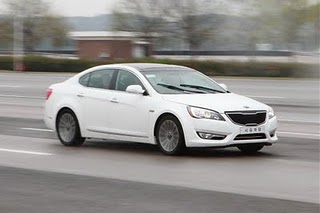
2012 kia cadenza

2012 kia cadenza

  1. 2012 kia cadenza
2012 kia cadenza
This past year was a rough one for automakers. The recession propelled manufacturers across the globe into one of the worst years for automotive sales in several decades, and some companies came out much worse for the wear. Even Toyota, a manufacturer that has been making headlines for its advancements in engine technology, was heavily affected by the ensuing melee, getting pounded by massive recalls and fuel economy technologies that threaten the top of the industry standing of its innovative Prius model. Even as the majority of automakers seemed to hit rock bottom, one manufacturer rose above the problems and made it a name for itself in 2009.
Amidst the failing auto market, Kia somehow managed to complete 2009 with some of the best numbers in the Korean automaker’s history. Sales were through the roof in 2009 for Kia, owing much to the brand’s unflinching promise to provide its reliable and fuel efficient cars for a much more modest asking price than most of the industry. With tight budgets everywhere, drivers were forced to evaluate cars that they might never have dreamed of buying, and it looks like visitors to Indianapolis Kia dealers were among those who were convinced that Kia is the real deal.
Now, to start off 2010, Kia has announced that it will move towards much the same excellence that made it a top-selling brand in 2009. The pricing for the 2011 Kia Sorento has just emerged, and I’d be surprised if Indianapolis Kia dealers didn’t see an influx of business as a result. The base model of the 2011 Sorento comes in just below 20k at $19,995 – a rather modest price for the five-seat unibody crossover powered by a 2.4-liter four cylinder and standard manual transmission. The engine pumps out a solid 175 horsies and 169 pound-feet of torque, lending its skills to the more upscale LX and EX models, although they come with automatic transmissions. When this vehicle comes to Indianapolis used Kia dealers, you can bet it will have a solid resale value.
But don’t count this vehicle as a regular at used Kia Indianapolis dealerships yet; it’s still got a lot of time on the market, one that has come to embrace the importance of fuel efficiency as of late. The Kia Sorento’s top model, the EX V6, offers a 3.5-liter V6 weighing in at 276 horsepower and 248 pound-feet of torque. You can choose from front- and all-wheel drive and an optional seven-seat version, providing for a ton more cargo and people room. Indianapolis used Kia dealers are sure to love the 2010 Kia Sorento when it hits shelves in the next couple of years.
As an emerging contender in the sport utility market, Kia is staying true to its own mission and values by providing a quality ride for an affordable price. Used Kia Indianapolis dealers already see a lot of play, but we expect the action to increase even more as Kia continues to move up in an industry marred by the sales results of 2009.
2012 kia cadenza
2012 kia cadenza

2012 mazda rx9

2012 mazda rx9


2012 mazda rx9
2012 mazda rx 9
Ever since 2005, the IRS has been giving a tax credit to individual taxpayers who drive cars which use alternative fuel sources. There was at one time just a clean fuel burning deduction available to green minded taxpayers, but this only applied to gas-electric hybrid vehicles. In 2005, however, this was replaced by the current legislation, the Energy Policy Act.
By the terms of this 2005 law, the tax credit is taken directly from the total amount of tax which the taxpayer would otherwise owe. This reduces or can even eliminate the tax which the individual in question must pay. If you are unsure whether or not your particular “green” vehicle qualifies for this credit, you can ask your car manufacturer or your local dealership.
If you have bought a hybrid vehicle after January 1 2006, then your vehicle (and you, happily!) qualify for this tax credit. This tax credit will also apply to your vehicle if you have begun to use your car after this date.
A hybrid vehicle is, by the definition given in this law a vehicle having drive trains which are powered by a rechargeable battery of some sort in addition to an internal combustion engine. Most hybrid vehicles which are available on the market currently do in fact qualify for this credit.
The credit provided for in the Energy Policy Act applies only to those who have purchased a new vehicle that meets these criteria. If this vehicle is leased rather than purchased outright by a consumer, it is the leasing company instead of the end user may claim this tax credit.
Let’s have a look at how large of a credit you will be eligible to receive for your hybrid vehicle. This information is current as of January 2008:
1. Make: Chevrolet
Model: Malibu Hybrid, Amount of Credit: $1,300
Model: Tahoe Hybrid 2WD and 4WD, Amount of Credit: $2,200
2. Make: Ford
Model: Escape Hybrid 2WD, Amount of Credit: $3,000
Model: Escape Hybrid 4WD, Amount of Credit: $2,200
3. Make: GMC
Model: Yukon Hybrid, Amount of Credit: $2,200
4. Make: Honda
Model: Civic CVT, Amount of Credit: $0 to $2,100 depending upon date of purchase.
5. Make: Mazda
Model: Tribute 2WD, Amount of Credit: $3,000
Model: Tribute 4WD, Amount of Credit: $2,200
6. Make: Mercury
Model: Mariner Hybrid 2WD, Amount of Credit: $3,000
Model: Mariner Hybrid 4WD, Amount of Credit: $2,200
7. Make: Nissan
Model: Altima Hybrid, Amount of Credit: $2,350
8. Make: Saturn
Model: Aura hybrid, Amount of Credit: $3,000
Model: Vue Green Line, Amount of Credit: $1,550
9. Make: Toyota
Model: Camry Hybrid, Amount of Credit: $0 to $2,600 depending on date of purchase
Model: Prius, Amount of Credit: $0 to $3,150 depending on date of purchase
Model: Highlander Hybrid 4WD, Amount of Credit: $0 to $2,600 depending on date of purchase
10. Make: Lexus
Model: RX 400h 2WD and 4WD, Amount of Credit: $0 to $2,200 depending on date of purchase
Model: LS 600h L Hybrid, Amount of Credit: $0 to $1,800 depending on date of purchase
2012 mazda rx9
2012 mazda rx9

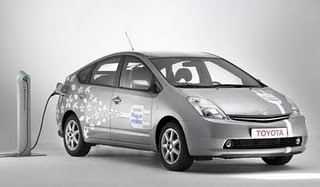
Toyota prius 2012

Toyota prius 2012


Toyota prius 2012


Back in the waning years of the previous millennium, the Toyota Prius was born, becoming the first Toyota hybrid. Since then, of course, many other Toyota and Lexus hybrids have hit the roads, as have many from nearly every other automaker. But it’s the Prius—thanks to distinct (if unsexy) styling and industry-leading fuel economy—that remains the unofficial greenmobile for Toyota and the world.
Naturally, then, the Prius is set to become the first Toyota to make the next big leap in fuel efficiency for 2012 by going plug-in with the new Prius PHV, or “plug-in hybrid vehicle.” And since 2012 is a long way off—in our impatient minds, at least—we jumped at the chance to drive one of the 150 powder-blue preproduction Prius PHVs bound for the U.S. in 2010. All are part of Toyota’s Prius PHV pilot program that places these vehicles with various utilities and government agencies to gather data on vehicle performance.
So how exactly does it differ? Other than silver paint on the mirrors, door handles, and tailgate, the blue-and-white “PLUG-IN HYBRID” lower door decals, and a cutout in the left front fender that houses the plug, there are no visible distinctions between the regular Prius and the PHV. Ditto the interior, where a few PHV-specific info displays and a slightly raised cargo floor for the PHV’s larger battery pack represent the only notable changes.
The Prius PHV doesn’t differ much from the regular Prius from a dynamic standpoint, either. No surprise, really. The Prius PHV is essentially just a Prius whose nickel-metal hydride battery pack has been swapped for a far pricier, far heavier, and far more potent lithium-ion pack. (How potent is unclear, as Toyota won’t tell us how much it improves on the regular car’s 1.3-kWh capacity.) The new batteries can be fully charged in three hours from a simple household 110-volt outlet or an hour and a half from a 220-volt plug. The battery swap allows for more miles on electricity alone and a commensurate boost in real-world fuel economy.
And so the parallel-hybrid powertrain design, the squishy suspension setup, and the puny 15-inch wheels remain, giving the PHV the same lackluster driving characteristics as its non-plug-in sibling. That includes the way-overboosted electric power steering and a brake pedal that has yet to deliver anything close to accuracy.
Going Farther, Faster on Electrons
The most palpable difference between the standard and PHV Priuses, then, is how a judicious right foot can direct the PHV to achieve and maintain speeds of up to 62 mph using electricity alone. Like a regular Prius, though, the PHV will fire up its internal-combustion engine if you’re not careful. The PHV’s threshold is slightly higher than the regular car’s, but anything more than genteel pressure on the go pedal—say, as might be required to enter the freeway or accelerate up a slight hill—and the 98-hp, 1.8-liter four-cylinder stirs with a decidedly unsexy moan.
Keep your driving grandmotherly, though, and a Prius PHV with a full charge can travel up to 13 miles in electric mode, which becomes considerably more novel the faster one travels. Once the battery pack is depleted, the car reverts to the conventional hybrid function of the standard Prius.
Even under full throttle, the PHV remains far from quick, with a 0-to-60-mph time of 11.3 seconds, according to Toyota, versus 9.8 seconds for the non-PHV model. Blame the heavier battery pack and its ancillary hardware—which add about 330 pounds—for the more sluggish time. But then, the Prius never has been and never will be about driving delight, but rather is about maximum fuel economy. At the end of the day, the PHV proof was not in the proverbial pudding but rather neatly displayed on the dashboard. Over a short city-and-highway loop, we were powered solely by electricity about 39 percent of the time, and we averaged 56 mpg, according to the in-car readout.
Two things are worth noting here: First, in-car fuel-economy readouts are notoriously optimistic. Second, the route was heavy on hills and included several miles of freeway driving, during which we frequently exceeded 80 mph. So although that 56-mpg figure might not be entirely accurate, even with a 10-percent margin of error, we recorded impressive economy for our usage. After our stint, our driving partner took the helm for a city route and spent nearly two-thirds of the time on the electron feed, bringing overall fuel economy up to 68 mpg for the trip, an increase of more than 50 percent over the last test figure we saw in a Prius.
Plug-In Prius Won’t Be a Match for Every Environmentalist
So what’s the holdup? Bring it on, right? First, Toyota is dotting its i’s and crossing its t’s before offering the technology to customers. Toyota is using this limited PHV program to gather real-world data to see if a 13-mile electric-vehicle range is sufficient to satisfy customers or if perhaps it needs to look into more- or less-potent battery packs. Toyota is also buying time to bring the price of the Prius PHV closer to what it considers the hybrid “sweet spot” of $15,000 to $27,000, which, at this point, it surely exceeds on account of that high-tech battery.
Once such targets are met and the final product is introduced sometime next year, what will become of the standard Prius? All signs indicate that it will soldier on and keep its nickel-metal batteries for a long time. Toyota reps tell us, “In conventional hybrid vehicles, Toyota will continue to use nickel-metal hydride batteries in the near term. The technology has proved its value over 12 years of mass production and is extremely reliable.”
Furthermore, Toyota says, the viability of plug-in technology can depend on an individual customer’s geographic location, drive cycle, and access to charging facilities. We would add income to that as well, since the Prius PHV will command a sizable premium over a comparably equipped standard Prius, although if Toyota hits its price target, it won’t cost as much as the Chevrolet Volt. Assuming costs go down, Toyota says lithium-ion batteries could be considered in the future for the many other hybrids found throughout the Toyota and Lexus lineups. Still, we consider this just another rest stop on the way to bigger and better technologies.
Toyota prius 2012
Toyota prius 2012

toyota yaris 2012

toyota yaris 2012


toyota yaris 2012


Toyota has been one of the most well known names in the car manufacturing industry for its subcompact cars that it has been releasing since 1999. Toyota has used the label “Yaris” to name the export versions of the several Japanese-market models. The Toyota Yaris 2012 is likely to move into the market by the mid of 2011 with a slightly polished style retaining the major attributes that it had in its previous generations. Toyota will offer 2012 Toyota Yaris in three different trim levels all of which will be available in oval shape, thereby heightening the interior of the 2012 yaris.
Toyota proposed this design because of the popular demands from people for a taller roofline as well as a spacious legroom that would offer extra comfort to the driver. This, however, has been one of the best features of several generations of 2012 Toyota Yaris designed, manufactured and launched by the renowned company. The emptor can avail the sport package to enhance the appearance of the car while purchasing. The package comprises of options of leather wrapped steering wheel, front seats with sporty look enveloped in classic fabric, a set of alloy wheels and a knob for transmission shifting.
toyota yaris 2012
toyota yaris 2012

Mitsubishi Electric i

Mitsubishi Electric i


Mitsubishi Electric i

The Evo is gone, the Ralliart is dead. Going forward Mitsubishi is going to become a builder of pure EVs and plug-in hybrid electric vehicles (PHEVs). So much so, that the new Mitsubishi North American president Yoichi Yokozawa just announced that no less than 8 EVs or PHEVs will be on sale by 2015. Mr. Yokozawa said that Mitsubishi will, "Become the kind ofcar company that society expects us to be, that the planet needs us to be." But what about the kind of company that consumers want? That remains to be seen, of course.
What is clear, is that the long awaited i (formerly known as the i MiEV) will be going on sale. How much? $27,990. A biggish chunk of change, for sure. But remember that electric vehicles get a $7500 federal tax credit, the price drops to a more likeable $20,490, making it the cheapest EV you can buy. And depending on which state you live in, this price could drop even further. In California, the i will most likely qualify for the full monty CRVP $5000 tax credit, effectively dropping the price to $15,490, making the i by far the cheapest EV there is. Nice, right?
When can you buy one? Tomorrow! No, really - it is Earth Day after all. Simply go to i.mitsubishicars.com and give them a $299 PayPal deposit plus $99 for a mandatory home electric inspection. But if you're one of the first 2000 people to put down a deposit, Mitsubishi will wave the $99 fee. Demo cars will show up at dealerships in November, and actual cars will be charging away in customers garages come January of 2012. With the high price of gas and the now seemingly inherently unstable nature of the petroleum market, Mitsubishi's i will probably find a few good homes.
Mitsubishi Electric i