Monday, 9 May 2011

Wiesmann Spyder

Wiesmann Spyder
Wiesmann Spyder


Geneva is the motor show about concepts and Wiesmann did not disappoint. Meet the Spyder, a car that for now is being termed a "design concept" but that depending on the usual array of metrics (media response, potential customer interest, state of the economy, worldwide malaise levels, etc.) they might put it into production. That wouldn't be the worst news we've ever heard.
As you can see, the fairly extreme Spyder has neither doors, a roof or a windscreen. Who needs 'em? This type of (very) open top motoring is sadly becoming a thing of the past, as comfort, high-tech and safety have basically taken over the motoring experience. However, if you've ever spent any time inside a Se7en (a real Lotus 7, Caterham or otherwise) then you already understand the Wiesmann Spyder's appeal.
Of course, getting into the Spyder is a whole other matter. And getting out looks difficult, if not fully impossible. Of course, I'll argue that practicality should never get in the way of a good concept. In that regard, the Spyder is a hit. In a world dominated by crossovers and safety concerns, it's refreshing to see throwback cars, no matter how impractical.
Wiesmann isn't providing too many specifics. They list the engine as a "V8 High Speed Motor," and that it makes 420 horsepower. They do claim that the weight is in the half a ton range, which is fabulous considering the power. The Spyder should be able to hit 60 mph in well under 4 seconds on its way to a top speed of 180 miles per hour. We say go for it.


 Wiesmann Spyder

Wiesmann Spyder
Wiesmann Spyder

volkswagen-golf-cabriolet-front-1.JPG

volkswagen-golf-cabriolet-front-1.JPG


 Designers appear to have crafted the BamBoo primarily as a means to encourage long stays on the beach. The waterproof cloth top can double as a blanket, and the inflatable rear seats can be removed and used as beach chairs. The passenger's portion of the dashboard contains a tablet PC and docking station, allowing users stay connected on the go. Rinspeed also seems keen on catering to social media junkies -- not only does the company suggest crafting a social media site exclusive to BamBoo owners, but a color-changing bird atop the roll bar is designed to express the driver's mood.
Driving, it appears, is less important than comfortable beach living. Power is provided by a 54-kilowatt (72 horsepower) electric motor, ensuring the 2400-pound BamBoo will be only slightly quicker than the two-cylinder Mehari. Rinspeed shies from battery details, but notes the BamBoo can travel 60 miles on a single charge.
For now, the BamBoo is simply a trivial concept, but Rinspeed suggests it could manufacture a small batch if consumer reaction at the Geneva show is overwhelmingly positive. Only time will tell, but we think a sand-tuned beachcomber may receive a better response in the French Riviera than in Switzerland...


 volkswagen-golf-cabriolet-front-1.JPG

volkswagen-golf-cabriolet-front-1.JPG 
volkswagen-golf-cabriolet-front-1.JPG

Volkswagen Go! and Tex

Volkswagen Go! and Tex

 Volkswagen Go! and Tex
Giugiaro and Volkswagen are names that have gone together for years, with the first-generation Rabbit/Golf and Scirocco to their credit. Now, with Giugiaro's Italdesign studio having been purchased by the VW Group, Giugiaro has been tasked with moving the VW brand's small vehicle lineage forward. The result are two concepts, Go! and Tex, which are being debuted at the 2011 Geneva Motor Show.
Each based on VW's modular transverse architecture, a highly versatile platform that can house a variety of body styles and powertrain configurations, the Go! and Tex are two entirely different vehicles. Go! represents the future of small VW hatchbacks. With the wheelbase of a Passat, but an overall length of 157 inches, the Go! features extremely short overhangs and maximized interior space. According to Giugiaro, the Go! has comparable interior volume to a large SUV and up to 18.5 cubic feet of cargo volume. Glass surfaces are maximized for better visibility and rear view cameras replace the door mirrors.
Driver and passenger windows are fixed, with only the lower half able to be lowered. This reduces the weight and complexity of the electric window motor, while allowing for adequate ventilation. Meanwhile, the side sliding door operates without tracks, keeping the mechanism from encroaching on passenger space. The electric rear hatch can be operated by passing a foot by the sensor under the rear bumper.
The interior of the Go! is designed ergonomically, featuring the same electronically-adjustable seats for all four passengers. The center console in between the two front seats can be retracted, allowing the driver to exit from the passenger door in the event of parking in an area with heavy traffic or when the driver's door is otherwise obstructed from opening. Instrumentation is placed at the base of the windshield, allowing the driver to keep focused on the road ahead. Power comes from an electric Blue-e-motion system with a range of up to 149 miles.

Volkswagen Go! and Tex 
Volkswagen Go! and Tex

Volkswagen Bulli Concept

Volkswagen Bulli Concept


The tale of Volkswagen's Bulli goes back to Wednesday, April 23, 1947. That's the day Dutch VW importer Ben Pon drew a rough sketch of the now internationally famous Transporter 1, or T1, van. In the States, it was known as the Microbus. In Germany, marketers labeled it the Bulli. And this year, in concept form at the 2011 Geneva show, the Bulli has returned with a retro-inspired design, modern usability, and a zero-emission electric powertrain.
The latest six-passenger Bulli is a reinterpreted reinterpretation of what's been billed as the world's first van. VW showed a retro van in 2001 at the Detroit auto show, and like that concept, the more evolved Bulli has a variety of simple, attractive, and classic traits.
The slightly extended nose, for instance, sports an extra-large "VW" badge in the middle of a distinct V-shape. Flanking it are bright L-shaped wraparound LED headlamps and dominant lower fog lights that add a bit of personality to the front clip, while slight intakes provide cool air to the electric powertrain.
The two-tone paintjob divides at the beltline and runs the vehicle's entire 156-inch length. Body panels were machined to portray a seamless look, and blacked-out pillars add a sense of size. The tailgate spans the Bulli's 68.4-inch width, making it ideal for loading cargo. Each corner sits on a chrome-dipped retro-look 18-inch alloy, and, as you can tell, the overhangs remain stubby.
Interior designers continued to meld modern style and classic cues by incorporating twin bench seats. Both can be folded down to maximize passenger comfort during trips, and if need be, the rear bench can completely stow, increasing overall interior space.

 Volkswagen Bulli Concept
Volkswagen Bulli Concept 
 Volkswagen Bulli Concept

2012 Volkswagen Tiguan

2012 Volkswagen Tiguan


 2012 Volkswagen Tiguan
While the revamped 2012 Volkswagen Tiguan won't officially be introduced to the world until its 2011 Geneva Motor Show debut, that won't stop interested European customers from buying them. VW has revealed that that the first examples are already rolling off the line and into into German showrooms.
So, what's new for 2012? A new look, at least for the exterior. Designers have reworked the Tiguan's form to bring it in-line with recent Volkswagen design trends, leaving it looking like a 2011 Touareg in three-quarters scale. New headlamps with LED running lights smoothly flow into a slender, broad grille. In back, the compact SUV receives new tail lamp assemblies, complete with interesting L-shaped lenses, echoing those used on its big brother.
These modifications, however, appear to be simply skin deep. The new Tiguan's cabin appears to be a carbon-copy of the last model, although engineers have thrown in a streamlined HVAC control interface, along with a color information screen within the gauge cluster. Switchgear previously placed just above the shifter has been relocated, allowing room for a keyless ignition button.
Expect even fewer changes to permeate the engine compartment. VW has yet to announce U.S. specifications for the revamped Tiguan, but the European model appears to still be offered with at a turbocharged 1.4-liter I-4, along with the ubiquitous 2.0-liter turbodiesel TDI I-4. We imagine U.S. models will continue to utilize the turbocharged 200-horsepower, 2.0-liter I-4 offered in today's model, although we'd love to see the TDI come stateside as a means to improve fuel economy.
U.S. pricing hasn't been announced, but seeing as the European model appears to avoid a price hike, expect the 2012 Tiguan to start near $24,540 when it arrives stateside later this year.

2012 Volkswagen Tiguan 
2012 Volkswagen Tiguan

Toyota Yaris HSD Concept

Toyota Yaris HSD Concept


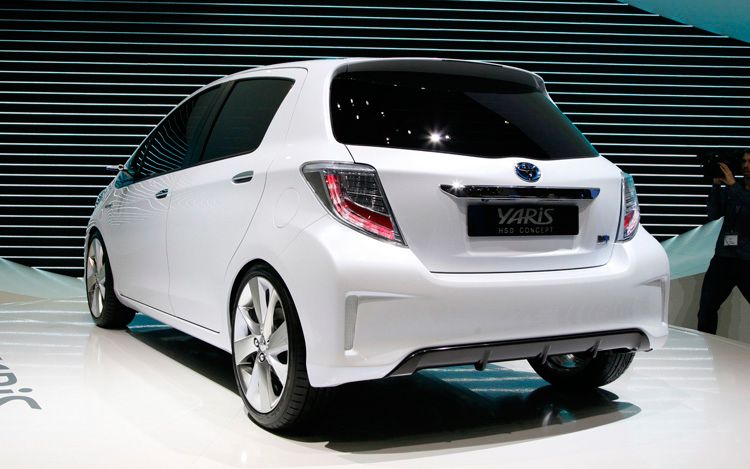
Honda may not be the only Japanese automaker readying a hybrid-electric variant of a B-segment hatchback. In keeping with a goal of offering an all-hybrid lineup in Europe by 2020, Toyota unveiled its Yaris HSD concept at the 2011 Geneva Motor Show, and indicated the car could be in production by the end of next year
The showcar is apparently based off the latest iteration of the Yaris/Vitz B-segment subcompact, which launched in Japan late last year, and is slated to arrive in other global markets within the next twelve months. For the most part, the concept bears a close resemblance to the stock hatchback, but designers have instilled some additional style by means of a few cosmetic touches. Up front, a dramatic fascia incorporates a massive lower grille section, teardrop-shaped side air intakes with fog lamps, and canted blue-tinted LED headlamps. That swagger is carried throughout the Yaris' exterior thanks to flared fenders, aggressive character lines, large eight-spoke aluminum wheels, and a tall rear bumper with an integrated diffuser.
Interestingly, Toyota is avoiding providing anything but a superficial look at the gas-electric Yaris. Although the model has been confirmed for production, the automaker has refrained from providing any firm specifications on the HSD concept's powertrain. Toyota's Hybrid Synergy Drive, which pairs a gasoline engine with an electric motor via an electrically variable transmission, is essentially a given, but we don't know what engine Toyota plans on stuffing underhood, but the 1.8-liter I-4 used in the Prius, Prius V and Prius+, Lexus CT200h, and the European Auris HSD may prove to be overkill. Look for a smaller four-cylinder offering (i.e. 1.3-1.5 liters or so) or Toyota's miniscule 1.0-liter three-cylinder to eventually work its way underhood.
Just how production ready this show car truly is remains to be seen (we're betting the LED headlamps and camera-based side-view mirrors are ditched before reaching consumers), but Toyota is apparently wasting no time in ushering it into production. The company has confirmed the Yaris HSD will be built at its plant in Valenciennes, France, and arrive in European showrooms in the second half of 2012.
Will the Yaris HSD ever arrive stateside? Company officials have shied away from answering that question, but it isn't likely. Seeing as the Valenciennes plant primarily builds Yaris models for European markets, we think the Yaris HSD -- much like Honda's Fit Hybrid -- may not be ported to North America.
Toyota Yaris HSD Front Three Quarter


 Toyota Yaris HSD Concept


Toyota Yaris HSD Concept 
Toyota Yaris HSD Concept

2012-toyota-prius-v

2012-toyota-prius-v
2012-toyota-prius-v


Although Toyota now offers Prii, it seems the Prius family isn't done expanding. The new Prius+, unwrapped at the 2011 Geneva Motor Show, attempts to blend the fuel economy of Toyota's famed hybrid with the seating capacity and practicality of a compact MPV.
If the new Prius+ looks familiar, it should. The new model is almost identical to the 2012 Prius V, which debuted earlier this year at the Detroit auto show. Both models are almost identical to the regular Prius hatchback from the A-pillars forward, but a 6-inch stretch in overall length and a taller roofline provide nearly 50 percent more cargo room.
Toyota claimed the Prius V stood for versatility, but ironically, the Prius+ may prove slightly more versatile. While the V retains seating for five, the Prius+ sports a small, third row of seating, bringing its passenger capacity up to 7. Those seating positions are perhaps best suited for small children (and on short trips, at that), but the 50/50 split bench can be folded flat for additional load space.
Mechanically speaking, the Prius+ is quite similar to both the Prius V and the original Prius. Toyota's Hybrid Synergy Drive continues to blend a 98-horsepower, 1.8-liter I-4 with an 80-horsepower electric motor through an electrically variable transmission. However, Prius+ models do ditch the typical nickel-metal hydride batter pack in favor of a lithium-ion battery -- a first for a production Toyota hybrid. The energy density offered by lithium-ion chemistry allowed engineers to craft a small battery and package it beneath the center console, potentially freeing up additional interior space.
As is the case with other Prius offerings, the Prius+ allows drivers to select from three different drive modes. An EV mode provides short spans of pure electric-powered driving. An ECO mode blends the engine and electric motor to achieve the best fuel economy possible, while the power setting combines both for maximum acceleration. Fuel economy figures haven't been announced for the Prius+, but it may perform similar to the Prius V. Toyota says Prius V models are estimated to achieve 42/38 mpg (city/highway) in EPA testing, which is down from the 51/48 mpg rating affixed to a standard Prius.
In North America, the Prius V may have no direct competition (except, perhaps, the Prius itself), but the Prius+ has its work cut out for it. The compact MPV segment is already crowded with vehicles like the Volkswagen Touran, Renault Scenic, Citroen C4 Picasso, and the Ford C-Max. Seeing as the Prius+ is expected to be priced in the low-30,000 pound range, only time will tell if the promise of hybrid technology, improved fuel economy, and the Prius' eco-friendly image will lure buyers into Toyota showrooms.

 2012-toyota-prius-v


2012-toyota-prius-v 
2012-toyota-prius-v